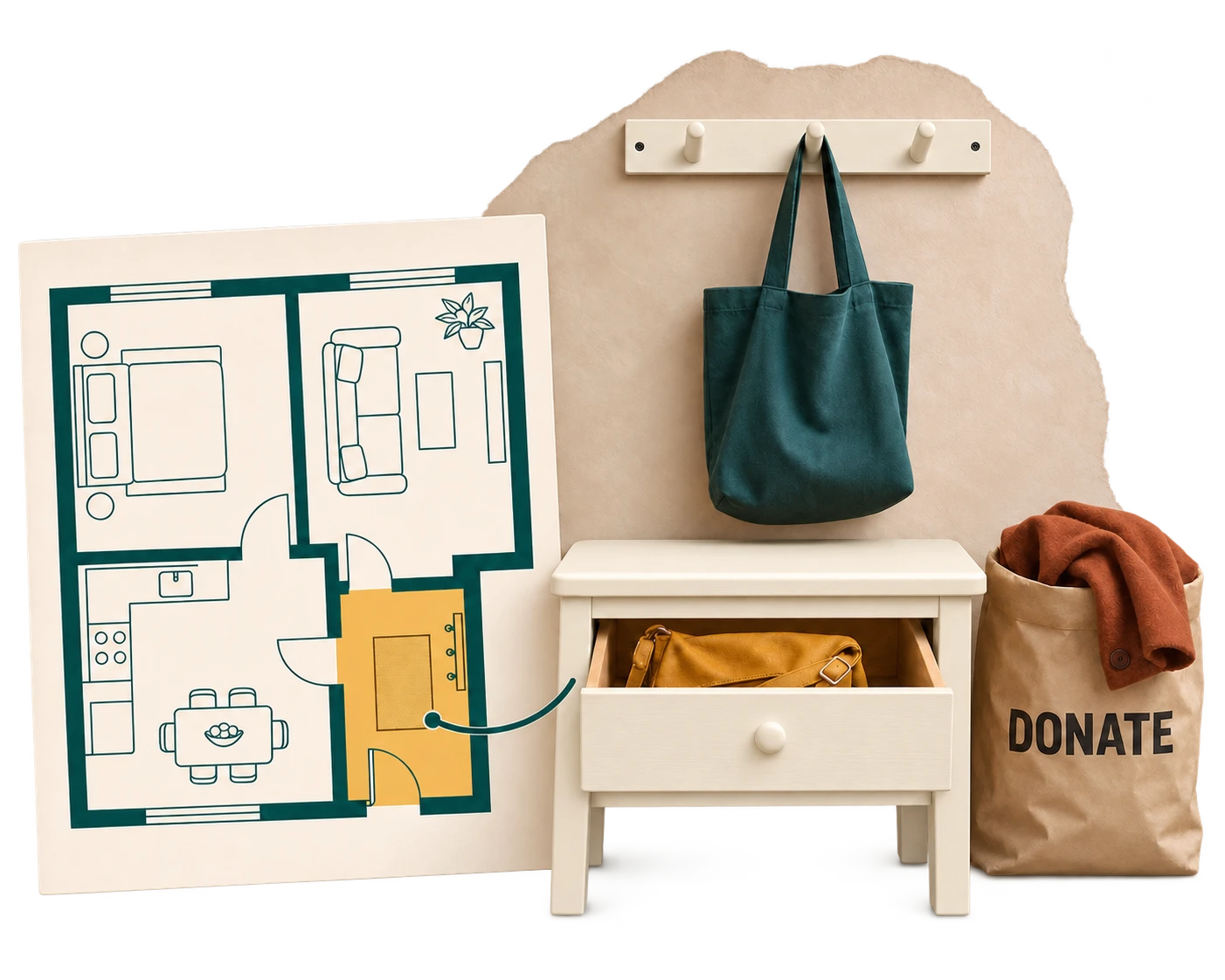
If you let me walk into your house for five minutes, I can tell you your organizing style before we even finish a cup of coffee. And no, I am not judging your messy junk drawer or that pile of laundry sitting on the chair. In fact, I am not looking at what is broken at all.
When I diagnose someone’s organizing style, I look at what is working.
Your organizing style comes down to a simple combination of two habits: how you naturally store your things, and how you naturally sort your things. When you try to force yourself into a system that fights those instincts, your house falls apart. But when you build systems that catch your everyday clutter where you naturally drop it, staying tidy becomes almost effortless.
Ready to do a little friendly snooping in your own house? Here is exactly what to look for.
Step 1: Discover How You Store (Visual vs. Hidden)
First, check the high-traffic zones you touch every single day—your kitchen, your entryway, and your bathroom vanity. Are your everyday essentials out where you can see them, or are they tucked away behind closed cabinet doors?
The Kitchen and Fridge
Take a quick look at your kitchen counters. Are your most-used appliances lined up along the backsplash? Is your spatula sitting in an open crock right by the stove?
Now look at your refrigerator. If your fridge front is covered in photos, reminders, coupons, and school notices, that is a classic sign of a visual organizer. (If you have a stainless steel fridge that does not hold magnets, you might see this same habit pop up as a corkboard on the wall or a little paper staging pile on the counter.)
The Bathroom Counter and Entryway
Next, peek at the bathroom. Do your daily morning face wash, toothbrush, and lotions live right out on the counter, or do you instinctively shove them into a medicine cabinet or drawer after using them?
Then head to the front door. When you kick off your shoes, do they land in a corner by the mat, or do they go into a closet? Do your coats hang from open wall hooks and door knobs, or do you tuck them onto hangers behind a closed door?
Why This Matters: The Root of Clutter Anxiety
This visual-versus-hidden divide is not about neatness—it is about anxiety.
- Visual organizers get anxious when things are tucked out of sight. For you, out of sight truly is out of mind. Subconsciously, your brain worries that if an item goes behind a solid door or into an opaque bin, it ceases to exist and you will forget about it.
- Hidden organizers get anxious when they see things out. Visual clutter on a flat surface feels like loud static in their brain, so their instinct is to put everything behind a closed cabinet, closet door, or drawer.
Keep in mind that storage exists on a spectrum. My bathroom counter might have products scattered on it on a busy weekday morning, but because the vast majority of my home functions best with clean surfaces and closed storage, I am fundamentally a hidden organizer. Look at your overall habits, not just one messy morning.
Step 2: Discover How You Sort (Detailed vs. Macro)
Once you know whether you need visual or hidden storage, you need to find out how you sort. This is where I get really snoopy. Open a few drawers and look at the tiny everyday items.
The Toothpaste Tube Test
Believe it or not, I can tell almost everything I need to know about someone’s sorting habits from their toothpaste tube.
A detailed organizer will use the tube neatly, put the cap back on every single time, and slowly roll it up from the bottom. That is my husband, Joe. He is a Cricket organizer, and his toothpaste tube looks like it belongs in a store display. (Sometimes I look at it and wonder: Is he even human?)
Then there is my toothpaste tube. I am a Ladybug. My tube is mangled, squeezed right from the middle, and usually missing its cap. I do not have the time or the mental patience to fiddle with a tiny cap when my brain has already moved on to the next five things on my to-do list.
Vacuum Cords and Linens
Another dead giveaway is your vacuum cleaner or your garden hose. When you finish vacuuming, do you take the time to wrap the cord neatly around the hooks? Or do you gather it into a loose heap and toss it at the base of the machine?
If you neatly wind cords and separate your linen closet into precise, folded categories, you lean toward detailed organization. If you toss cords in a bundle and prefer broad, fast drop zones, you are a macro organizer.
- Detailed organizers (Micro) prefer sub-categories. They love individual drawer dividers, separate files, and precise spots for every single item.
- Simple organizers (Macro) need fast and easy systems. They thrive with broad categories—like one big basket for all winter accessories, or a single bin for hair products—so they can toss things in without pausing.
The Four Styles: Stop Organizing for Your Fantasy Self
When you put your storage preference and your sorting preference together, you get your Clutterbug organizing style:
- Butterfly: Visual storage + Simple (Macro) sorting. You love open bins, clear containers, hooks, and broad categories.
- Bee: Visual storage + Detailed (Micro) sorting. You love seeing your projects and tools out in the open, neatly separated into precise, labeled sub-categories.
- Ladybug: Hidden storage + Simple (Macro) sorting. You need clean, clutter-free surfaces and closed cabinets, but the storage inside needs to be fast and easy (think big bins, baskets, and deep drawers without fussy lids).
- Cricket: Hidden storage + Detailed (Micro) sorting. You love closed doors and clean surfaces, paired with meticulous inner organization, dividers, and precise filing systems.
Here is the golden rule: Do not organize for your fantasy self.
We all look at Pinterest and think we want rainbow-coded bookshelves, twenty tiny labeled drawer trays, and immaculate pantries. But if you are a macro organizer, setting up a system with fourteen sub-folders and micro-trays is just setting yourself up to fail. Within a week, the clutter will pile up on top of the counter because putting things away takes too many steps.
Being a visual organizer does not mean you like clutter, either. Nobody likes visual chaos. It simply means that your everyday essentials need open, accessible homes—like pretty open baskets, decorative hooks, and clear bins—so you can find what you need without fear of losing it.
Your Five-Minute Next Step
Take five minutes today and walk through your home with an investigator’s eye. Check your kitchen counters, peek at your toothpaste tube, and look at your vacuum cord.
Stop feeling guilty about what isn’t working, and start noticing how you naturally operate. Once you know your style, you can stop fighting your instincts and start building a home that works with you.
Want to confirm your bug type? You can take the free quiz on the Clutterbug website or grab the free Clutterbug eBook to dive deeper into the four styles and see how to set up systems tailored specifically to your brain.