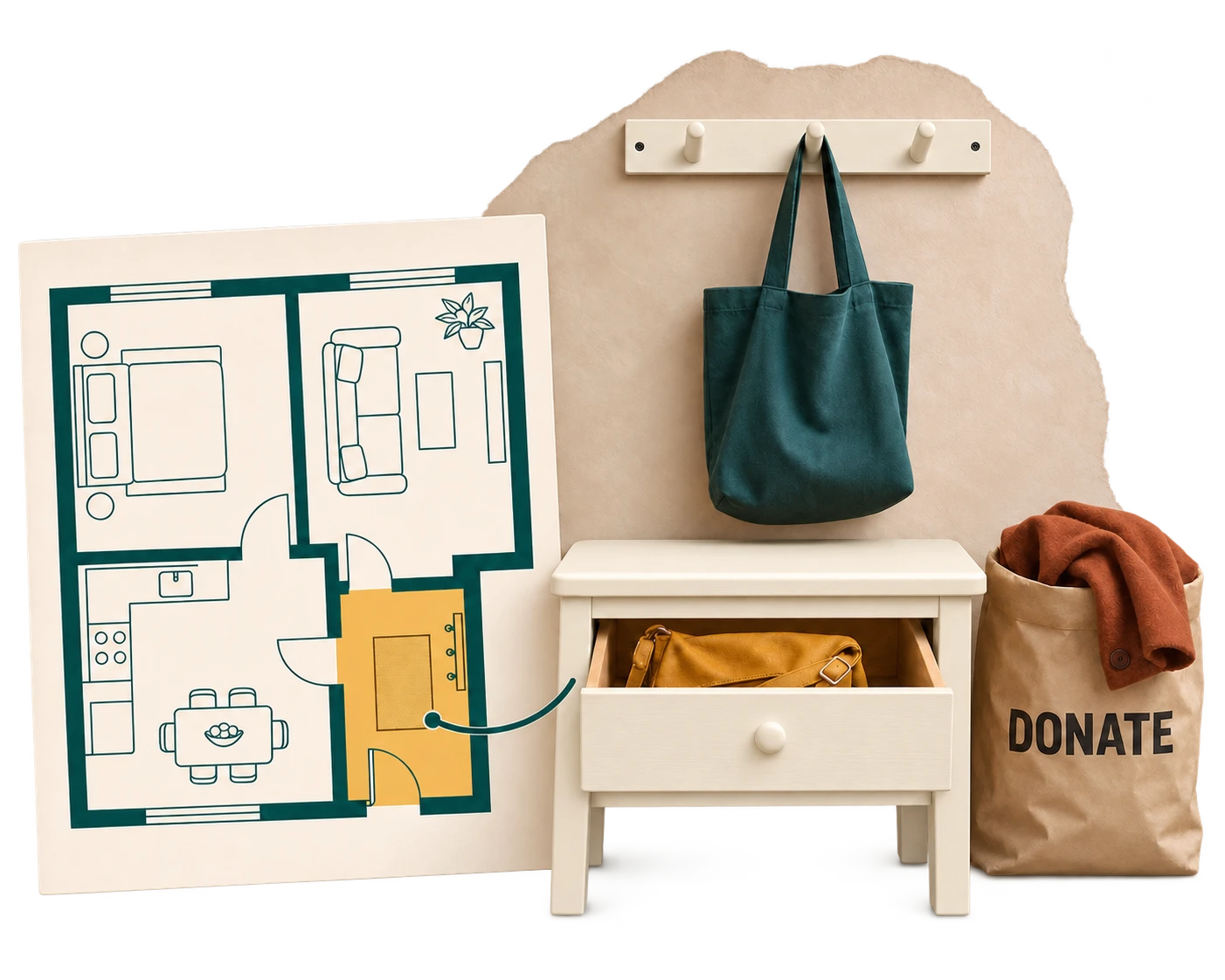
If your home does not have a mudroom or an attached garage, your front entryway closet has to do an impossible amount of heavy lifting. It is not just holding a couple of winter jackets. It is holding backpacks, soccer gear, dog leashes, work bags, and mountains of shoes. When that space stops functioning, you feel it immediately. Coats get tossed onto the stairs, backpacks hit the kitchen island, and shoes pile up in an obstacle course by the front door.
I recently tackled a tiny hall closet makeover with Stephanie, and it is the perfect example of how a few practical tweaks can turn total chaos into calm. Stephanie is about 75% Butterfly and 25% Ladybug, which means she is visual and thrives on macro-organization—broad, easy-to-use systems that do not require twenty fussy steps to put something away.
Here is how we completely transformed her small closet so her busy family of four could actually keep it tidy.
The Barn Door Dilemma: Pretty vs. Practical
When we looked at Stephanie’s closet, the first big issue was not the stuff inside—it was the doors. She had gorgeous sliding barn doors installed, but because of the staircase right next to the closet opening, the doors could not slide open all the way.
Sliding doors that cannot fully open cut your usable closet space right in half. Every time someone came home with full hands, sliding that heavy door over was just enough friction that nobody bothered. Instead, things were kicked into the doorway, left on the banister, or dumped on the stairs.
In an ideal world, regular doors that swing out with hooks on the back would be fantastic here. But right now? The fastest, highest-impact solution was simple: we took the barn doors completely off.
Taking doors off can feel a little intimidating, but for a visual organizer, seeing everything at a glance removes the barrier to putting things away. It immediately opened up the hallway and made every square inch of the closet accessible.
Protecting Your Most Valuable Real Estate
A small front hall closet is prime real estate. If you do not have another drop zone on your main floor, you cannot afford to let this closet store things you only touch twice a year.
When we pulled everything out to sort, we had to get honest about what truly belonged by the front door:
- The 17-pair shoe problem: Stephanie’s husband had 17 pairs of running shoes crammed into this single small closet! You do not need 17 pairs of sneakers at the front door. We challenged that habit: keep your top three or four everyday pairs here (plus your lawn-mowing shoes), and move the specialty or backup pairs to the basement or bedroom closet.
- Outgrown kids’ gear: We immediately found coats that the kids had clearly outgrown over the last year. Off to the donation pile they went.
- Seasonal storage: Specialty sports gear, car-cleaning supplies, and items you do not reach for daily can still live in the closet, but they belong on the absolute top shelves, out of the prime everyday reach zone.
The Wild Things You Find When You Declutter
Decluttering an entryway closet is never boring. You always find things that make you stop, laugh, and wonder how on earth they ended up there.
Stephanie’s closet might take the trophy for the most memorable finds. We pulled out vent attachments meant for drying wet mittens, a hilarious gag gift her husband bought online, and an actual leash and harness for her pet chicken (her kids genuinely take their chicken for walks!).
And then there was her husband’s emergency "wilderness survival" backpack kept right by the door at a moment’s notice. When we looked inside to see what essentials were ready for the zombie apocalypse, we found: one giant survival knife, a water filtration straw, a full bottle of sunscreen (because sun safety comes first during an apocalypse), and exactly two loose, unwrapped Tums. No matches, no bandages, no food—just sunscreen and two Tums! You truly never know what is hiding in the back of a closet until you empty it out.
Setting Up Systems for Real Life
Once the closet was empty and decluttered, we set up systems designed specifically for how Stephanie’s family moves:
1. Low Hooks for Kids
Instead of making young kids fight with hangers on a high closet rod, we raised the upper shelving and added low hooks. Now the kids can easily hang up their own coats and backpacks without asking for help. Better yet, moving the kids’ jackets down freed up the main hanging rod so grown-up coats have room to breathe, with leftover space for guests to hang a jacket.
2. Big Floor Baskets Instead of Shoe Racks
Shoe racks look neat in theory, but for macro organizers, trying to line up muddy shoes on narrow wire shelves is a recipe for a pile on the floor. We pulled out the low shelving and placed two large, sturdy baskets directly on the closet floor. Now the kids can literally kick their everyday shoes right into the baskets. Fast, painless, and completely off the hallway floor.
3. Solid, Labeled Bins Up High
Because the doors are off, we wanted the closet to look tidy without demanding perfection. We used solid bins with simple labels for hats, mittens, sporting equipment, and work bags. Solid bins hide visual clutter while the broad categories make it easy for everyone in the house to find what they need.
Your Small Next Step
If your front closet feels like a daily battleground, take five minutes to look at where the friction is happening:
- Are kids struggling to reach high hangers? Add a few low stick-on hooks or over-the-door hooks.
- Are shoes piling up right in front of the door? Swap the shoe rack for a big drop basket.
- Is the space crammed with stuff you have not touched in months? Relocate the extras to free up your everyday real estate.
You do not need a giant mudroom to have an organized entryway. When you design the space around how your family naturally behaves, even the smallest closet can work like a dream.
For more easy, clutter-free inspiration and practical organizing tips, explore the resources over at Clutterbug.